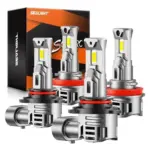
Swapping halogen bulbs for LEDs sounds straightforward until you realize the housing shapes the beam, not just the bulb. A projector and a reflector housing handle light in fundamentally different ways, and that difference determines whether your LED upgrade produces a clean, road-legal beam or a scattered, blinding mess. Understanding the optical mechanics behind each housing type is the first step to getting the upgrade right.
How Reflector Housings Work
Reflector housings are the older of the two designs and still appear on a wide range of vehicles produced through the mid-2000s. The housing is essentially a mirrored bowl that surrounds the bulb. When a halogen filament sits at the focal point of that bowl, the curved mirror directs light forward in a controlled pattern. The geometry is calibrated specifically around the size, shape, and position of a halogen filament. LED bulbs present an immediate problem here. An LED emitter is physically different from a halogen filament: it produces light from a flat chip rather than a glowing wire, and the light radiates in a different direction relative to the socket axis. When you place that LED emitter into a reflector housing designed for halogen, the mirror no longer receives light at the angles it was built to redirect. The result is a beam with hot spots, dark gaps, and significant scatter above the cutoff line. That scatter is what blinds oncoming drivers. Some LED bulbs are engineered with the chip oriented to better approximate a halogen filament’s position, which helps partially. But even well-designed LED replacements rarely replicate halogen performance in a reflector housing without some compromise to beam pattern or light distribution.
How Projector Housings Work
Projector housings arrived in mainstream vehicles around the early 2000s and are now standard on most newer platforms. The design centers on a precisely shaped lens at the front of the housing and a sharp cutoff shield positioned behind it. Light from the bulb hits a small elliptical reflector, passes through the shield, and exits through the lens in a tightly controlled output. The cutoff shield is what creates the hard, flat upper edge you see with projector low beams. That hard cutoff is exactly what makes projector housings far more compatible with LED bulbs. Because the lens and shield do the beam-shaping work, the system is less sensitive to the precise origin point of the light source. An LED emitter placed reasonably close to the focal point of a projector housing will still produce a recognizable beam pattern, though alignment and emitter geometry still matter. The best LED performance in projector housings comes from bulbs specifically designed for the application, with the emitter positioned at a comparable depth and angle to the original halogen. The H4 LED headlight bulb options reviewed on this site include several models built with projector compatibility in mind, with emitter placement data listed in the specs.
Why LED Chip Orientation Matters in Either Housing
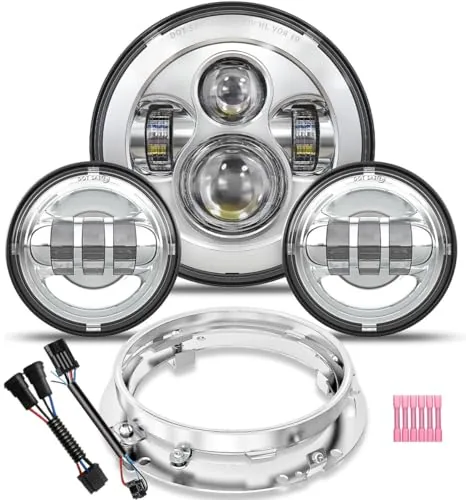
Even within each housing category, LED chip orientation is a variable that most buyers overlook. Halogen bulbs emit light in a 360-degree arc around the filament because the filament is a physical wire suspended in space. LEDs emit primarily from one face of the chip. In an H4 or H7 socket, the direction that face points when the bulb is seated determines whether light hits the reflector bowl or projector lens at the correct angle. Some LED manufacturers orient the chip horizontally to simulate the halogen filament’s broadside emission. Others place it vertically. The wrong orientation in either housing produces a noticeably degraded pattern. For reflector housings, horizontal chip orientation typically performs better because it more closely mimics the light distribution plane of a halogen filament. For projector housings, the relationship is less critical because the lens geometry tolerates some variation, but orientation still affects how evenly the beam fills the lens. When evaluating any LED bulb for a housing swap, look for published beam pattern photos taken with the bulb installed in your specific housing type. Manufacturer lumen claims tell you nothing about where that light actually goes once it enters the housing. Motorcycle LED headlight upgrades run into the same optical constraints (see the motorcycle LED headlight comparison for how housing geometry plays out in that context).
Which Housing Should You Choose for an LED Upgrade
If your vehicle has a reflector housing and you want to run LEDs, the most reliable path is replacing the housing assembly with an aftermarket projector unit rather than fighting the optical mismatch with a better LED bulb. Projector retrofit kits exist for most common vehicles and give you a housing that was designed with controlled beam output from the start. Pairing a quality LED bulb with a purpose-built projector housing consistently outperforms any reflector-plus-LED combination in real-world beam tests. If a full housing swap is not on the table, look specifically for LED bulbs marketed with reflector-optimized chip geometry and check third-party beam pattern photos before buying. Avoid any LED that simply claims higher lumens without addressing chip orientation or housing compatibility. For vehicles that already have factory projector housings, LED upgrades are more forgiving, but you still want a bulb with an emitter that sits at approximately the same depth as the original halogen. Many modern trucks and SUVs ship with projector housings as standard equipment, which is why model-specific aftermarket headlight reviews, such as the coverage of F-150 headlight upgrade options, often note projector compatibility as a primary selection criterion. The housing type you have shapes every decision downstream from it.
Reflector housings are poorly suited to LED retrofits because their optics depend on the specific light distribution of a halogen filament. Projector housings tolerate LED emitters far better due to the lens and cutoff shield doing most of the beam-shaping work. Before buying any LED bulb, confirm your housing type, check published beam pattern photos for that bulb-and-housing combination, and treat lumen output as secondary to where that light actually lands on the road.
Affiliate Disclosure
This post contains affiliate links. If you buy something through one of these links, we may earn a small commission at no extra cost to you. We only recommend products and services we trust. Thank you for supporting this site!