Chase light bars and standard emergency light bars are often confused because both mount on vehicles and use high-output LEDs. The confusion is understandable at a glance, but their intended functions, flash patterns, and mounting configurations are genuinely different. Understanding those differences helps you choose the right tool for the job, whether you’re outfitting an off-road rig, a utility vehicle, or an emergency response setup.
What a Chase Light Bar Is Designed to Do
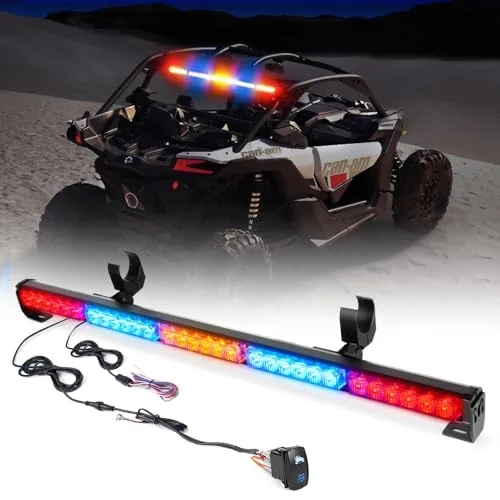
A chase light bar gets its name from the sequential LED firing pattern that creates the visual impression of light moving from one end of the bar to the other. This running or “chasing” sequence is the defining feature. The goal is rearward visibility and warning, not forward illumination. Chase bars are mounted at the rear of UTVs, off-road trucks, and side-by-sides so that following vehicles, spotters, and trail crews can track position in dusty or low-visibility conditions. The amber or red sequential flash is immediately readable as a direction signal even when dust or debris obscures the vehicle itself. Because the primary audience is behind the vehicle rather than oncoming traffic, the optics are oriented rearward and the beam is wide-angle rather than focused. Most chase bars also include steady-burn modes and standard strobe patterns alongside the sequential chase function, giving operators flexibility depending on the situation. The chase light bar buying guide covers how flash pattern count and lens angle vary across specific models. Build quality on chase bars tends to prioritize vibration resistance and water ingress protection, since off-road use exposes them to conditions that would damage a standard dash-mount emergency bar.
How Standard Emergency Light Bars Differ in Function
Standard emergency light bars are built around the goal of commanding attention from all directions, particularly from oncoming traffic. Law enforcement, fire apparatus, and EMS vehicles need drivers ahead and to the sides to yield and clear a path. To accomplish that, emergency bars are engineered with forward-facing takedown lights, intersection lights that project to the left and right, and alley lights angled to illuminate roadsides during traffic stops. The flash patterns are optimized for daytime and nighttime visibility in urban environments, often combining split-second strobe pulses with steady or rotator-style segments. Color selection is also more constrained. Most jurisdictions specify red and blue for emergency use, with amber reserved for caution or utility applications. This regulatory dimension shapes the entire product category. Emergency bars also carry certifications, most commonly SAE Class 1 or Class 2 ratings in the U.S., which define minimum flash intensity and pattern requirements. A chase bar designed for trail use typically carries no such rating and would not satisfy legal requirements for roadway emergency use. The two categories share LED technology and waterproofing standards but diverge sharply in optics, pattern programming, and certification.
Mounting, Size, and Power Draw Compared
Chase light bars are almost always mounted horizontally at the rear of a vehicle, typically along the cab roof edge, the rear bumper, or a roll cage. Standard lengths run from 20 inches to 50 inches to match the rear profile of common UTVs and trucks. Power draw is relatively modest because the sequential pattern uses only a portion of the LEDs at any moment rather than firing all segments simultaneously. A typical 40-inch chase bar draws between 20 and 40 watts during normal operation. Standard emergency light bars span a wider range. Roof-mount full-size bars for police or fire vehicles can run 48 to 72 inches and draw 80 to 150 watts when multiple zones fire simultaneously. Compact dash-mount or visor-mount emergency bars are smaller, but they still prioritize multi-directional output over the single rearward focus of a chase bar (see the emergency light bar guide for how wattage and certification tier relate across form factors). Mounting hardware also differs: emergency bars use permanent roof brackets or magnetic bases suited to flat roof panels, while chase bars often mount via roll cage clamps, stake pocket adapters, or rear bumper brackets specific to off-road vehicles.
When to Use One Over the Other
The choice between a chase bar and an emergency bar comes down to the direction you need visibility and the legal context you’re operating in. If you’re running a UTV sweep in a desert race, coordinating a vehicle convoy, or simply making your rear profile visible to other drivers on a trail, a chase bar is the right tool. The sequential pattern reads as directional warning and is well understood in off-road and motorsport contexts. If you’re a volunteer firefighter, a construction flagger with road closure authority, or a tow truck operator working on a live highway, you need an emergency bar that meets your state’s SAE classification requirement. Using a chase bar in a roadway emergency context creates legal exposure and may not produce enough forward or lateral output to actually clear traffic. There is some overlap in the utility space: rural road maintenance crews and agricultural vehicles sometimes use amber chase bars as general hazard markers, which is legal in most states without an emergency classification. Off-road lighting more broadly, including the differences between supplemental forward lighting and warning systems, follows a similar split between visibility tools and regulatory equipment. Knowing which category your application falls into before you buy saves both money and compliance headaches.
Chase light bars and standard emergency light bars solve different problems with similar technology. Chase bars provide rearward sequential warning suited to off-road and convoy use. Emergency bars provide certified, multi-directional output for roadway emergency response. Swapping one for the other introduces either a gap in visibility coverage or a legal compliance issue. The LED hardware and waterproofing between categories have largely converged, but the optics, flash pattern programming, and certification requirements remain distinct. Matching the bar type to the actual use case is the only decision that matters here.
Affiliate Disclosure
This post contains affiliate links. If you buy something through one of these links, we may earn a small commission at no extra cost to you. We only recommend products and services we trust. Thank you for supporting this site!